
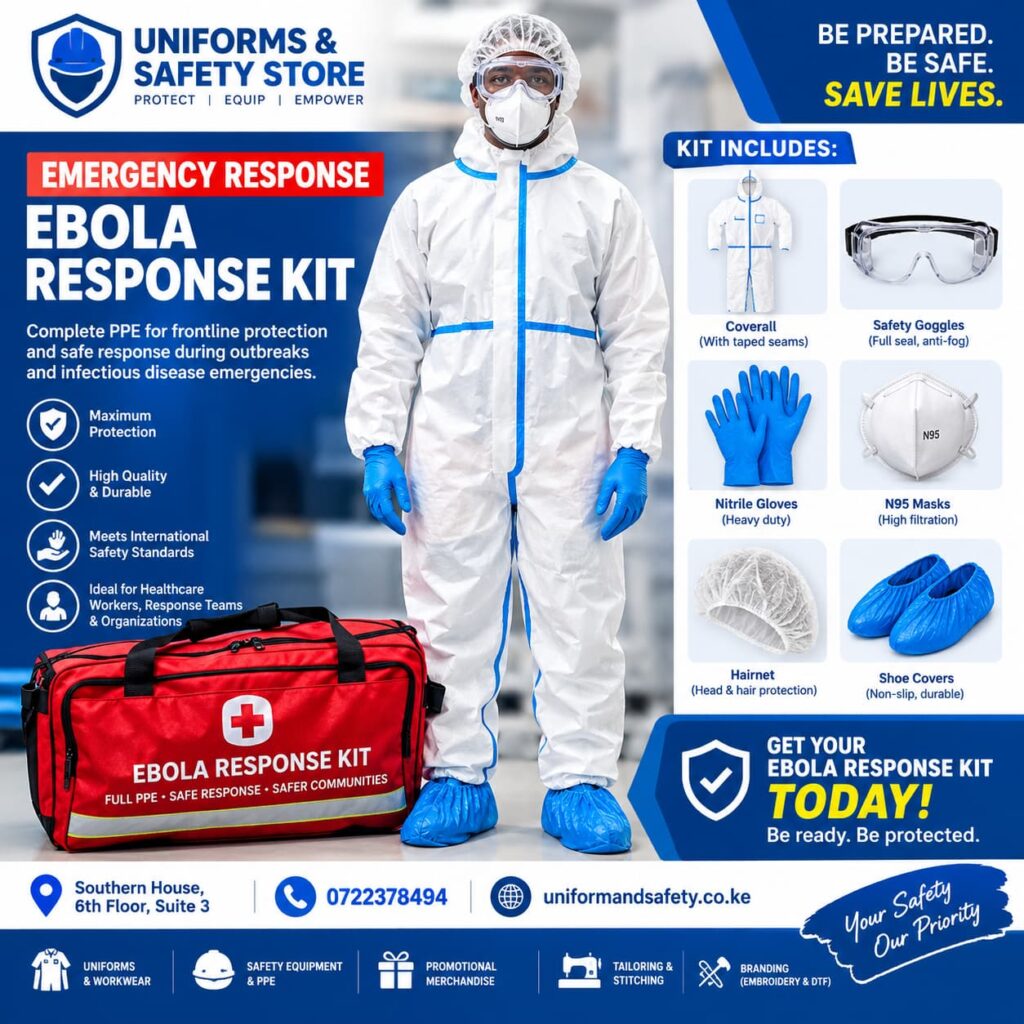
Be Prepared: Protecting Healthcare and Response Teams During Ebola Emergencies
When an Ebola outbreak occurs, preparedness is critical. Healthcare workers, emergency responders, laboratory personnel, caregivers, and other frontline teams may face a higher risk of exposure to infectious body fluids. Having the appropriate Personal Protective Equipment (PPE) available before an emergency occurs can help support safer infection prevention and control practices.
A well-prepared Ebola PPE kit should contain appropriate protective clothing and equipment designed to reduce potential exposure when used correctly and together with proper infection prevention procedures.
What Should an Ebola PPE Preparedness Kit Include?
Our Ebola PPE preparedness kit can include essential protective items such as:
1. Protective PPE Coverall
A protective coverall provides coverage for the body and clothing and can help reduce the risk of contamination from potentially infectious materials.
For Ebola response activities, coveralls should be selected according to the specific risk assessment and applicable healthcare or occupational safety requirements. Proper donning and doffing procedures are equally important.
2. Protective Gloves
Gloves provide a barrier between the hands and potentially infectious materials. Depending on the task and exposure risk, appropriate disposable gloves may be required, with additional gloves used where recommended by infection-control protocols.
Gloves should be correctly fitted and changed according to established procedures.
3. Hairnet or Head Cover
A hairnet or protective head cover helps cover the hair and reduce contamination of the hair and scalp during activities where exposure to infectious materials is possible.
It should be worn correctly as part of the complete PPE ensemble.
4. Shoe Covers
Disposable shoe covers can help protect footwear from contamination in environments where spills or contact with infectious materials may occur.
For higher-risk situations, facilities should select footwear protection based on their infection-control risk assessment and applicable guidelines.
5. Gumboots
Protective gumboots can provide durable footwear protection for environments where there may be significant exposure to fluids, spills, or contaminated surfaces.
They should be easy to clean and disinfect and suitable for the work environment.
6. N95 Respirator
An N95 respirator is a respiratory protective device designed to filter airborne particles. Where respiratory protection is indicated, the respirator should be properly selected, fitted, and used according to the applicable infection-control and occupational-safety requirements.
Importantly, an N95 should not be viewed as a substitute for the complete PPE ensemble or other infection-prevention measures.
Why Ebola PPE Preparedness Matters
During an Ebola response, PPE supplies may become difficult to obtain when demand increases suddenly. Preparing supplies in advance can help organizations respond more efficiently and ensure that frontline personnel have access to appropriate protective equipment when it is needed.
A preparedness kit can be particularly useful for:
- Hospitals and healthcare facilities
- Clinics and isolation units
- Ambulance and emergency-response teams
- Laboratories and sample-collection teams
- Humanitarian organizations
- Infection prevention and control teams
- Emergency preparedness programs
- Organizations preparing outbreak-response stock
PPE Alone Is Not Enough
It is important to understand that PPE is only one component of Ebola infection prevention and control.
Safe Ebola response also requires appropriate training, risk assessment, isolation procedures, environmental cleaning and disinfection, waste management, hand hygiene, safe patient care practices, and correct donning and doffing of PPE.
Personnel should follow the latest guidance from relevant public-health authorities and their organization’s infection prevention and control procedures.
Prepare Before an Emergency
The best time to prepare an Ebola PPE supply is before an outbreak creates an urgent demand for protective equipment.
Organizations should review their PPE requirements, identify trained personnel, establish appropriate storage arrangements, monitor stock levels, and ensure that staff understand how to correctly use and remove PPE.
A properly planned PPE preparedness program can help organizations respond more confidently when infectious-disease emergencies occur.
Build Your Ebola PPE Preparedness Kit
Our uniforms and safety solutions can help organizations source essential protective equipment for emergency preparedness and infection-control requirements.
Our Ebola PPE preparedness kit can be configured to include:
PPE Coverall + Gloves + Hairnet + Shoe Covers + Gumboots + N95 Respirator
For organizations preparing healthcare, emergency-response, or infection-control supplies, we can provide PPE options based on your operational requirements and intended use.
Prepare early. Protect your team. Be ready to respond. :::
I’ve kept the medical claims appropriately cautious because Ebola PPE selection should be based on the exposure risk and current public-health guidance, rather than implying that this exact six-item combination is universally sufficient.